
Hair fall is a common concern for both men and women. Seeing extra hair on your pillow, comb, bathroom floor, or shower drain can make you wonder whether you need a special shampoo. With so many products marketed as “anti-hair fall,” “hair strengthening,” or “hair growth” shampoos, choosing the right one can be confusing.
The important thing to understand is that not every type of hair fall has the same cause. Hair shedding can be associated with genetics, stress, illness, nutritional deficiencies, hormonal changes, scalp conditions, certain medicines, or hair-care practices. Therefore, the right shampoo should be selected according to your scalp condition, hair type, and specific concerns rather than simply choosing the product with the strongest claim.
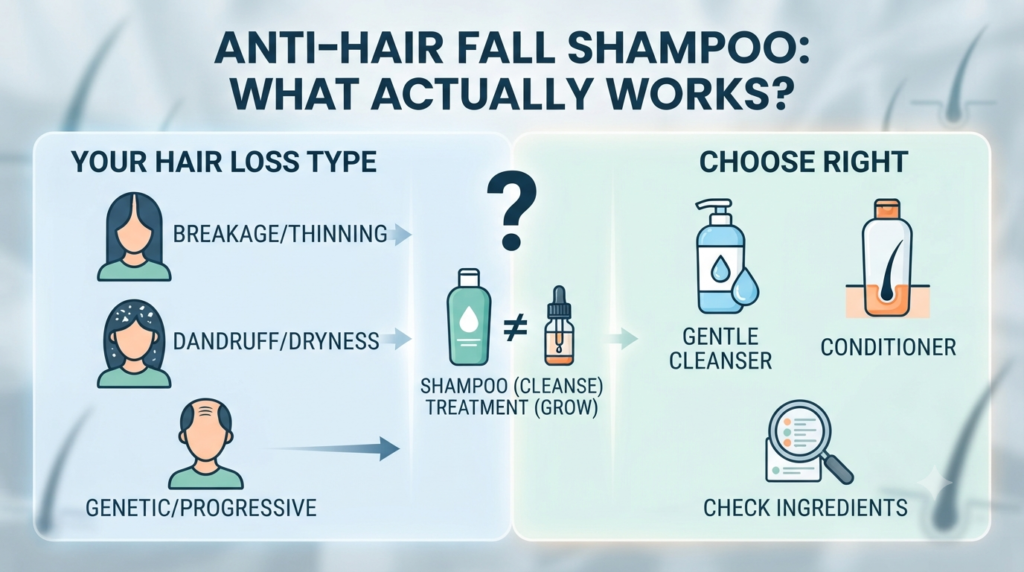
What Does an Anti-Hair Fall Shampoo Actually Do?
An anti-hair fall shampoo is primarily designed to cleanse the scalp and hair while helping maintain a healthy hair-care environment. Depending on its formulation, it may help reduce dryness, excess oil, scalp buildup, or hair breakage.
However, it is important to distinguish hair breakage from hair loss. A shampoo can help improve the condition of the hair shaft and reduce breakage, making hair appear healthier and fuller. It generally cannot reverse conditions in which hair follicles are progressively shrinking or being affected by an underlying medical problem.
The American Academy of Dermatology notes that hair-loss shampoos may help hair retain moisture and reduce breakage, but they cannot regrow hair or prevent hair loss from worsening.
Step 1: Understand Why Your Hair Is Falling
Before buying an anti-hair fall shampoo, consider what you are actually experiencing.
Some people experience temporary increased shedding after significant stress, illness, surgery, childbirth, or other physical changes. Others may have gradual thinning related to hereditary hair loss. Scalp infections, hormonal problems, nutritional deficiencies, tight hairstyles, and chemical or heat damage can also contribute to hair loss.
If your hair loss is sudden, severe, persistent, or accompanied by visible bald patches, scalp inflammation, or significant thinning, a shampoo should not be your only approach. Identifying the underlying cause is an important part of managing hair loss.
Step 2: Choose a Shampoo According to Your Scalp Type
Your scalp condition should play an important role when selecting a shampoo.
Oily Scalp
If your scalp becomes oily quickly, look for a shampoo that provides effective cleansing without leaving the scalp excessively dry. Excess oil, sweat, and product buildup can make the scalp feel greasy and uncomfortable.
Avoid applying heavy oils or conditioners directly to the scalp if they make your scalp more oily. Conditioner is generally better applied mainly to the lengths and ends.
Dry or Sensitive Scalp
If your scalp feels tight, dry, itchy, or easily irritated, choose a gentle shampoo designed to cleanse without excessively stripping moisture.
Dermatologists recommend gentle shampooing for people experiencing hair loss because thinning hair can be fragile and more susceptible to damage.
Dandruff-Prone Scalp
If hair fall occurs alongside persistent dandruff, flaking, itching, or scalp irritation, consider whether you need a shampoo specifically formulated for the scalp condition rather than a general anti-hair fall shampoo.
Treating the scalp problem may be more important than simply choosing a product labelled “hair fall control.”
Step 3: Look at the Ingredients
Don’t choose a shampoo based only on its front-label claims. Read the ingredient list and understand what the formulation is intended to do.
Caffeine
Caffeine is frequently included in shampoos marketed for hair loss. However, the evidence supporting hair-loss claims for shampoo formulations is not as strong as many advertisements may suggest. A recent review of trichological shampoos found that evidence for many ingredients marketed as anti-hair-loss actives remains limited.
Ketoconazole
Ketoconazole-containing shampoos may be useful in specific scalp conditions, particularly when dandruff or certain fungal-related scalp problems are involved. These products should be used according to the product instructions or medical advice, especially when the scalp problem is persistent.
Moisturizing and Conditioning Ingredients
Ingredients that help maintain moisture and improve hair feel can be useful when breakage and dryness are contributing to the appearance of thinning hair. A moisturizing conditioner after shampooing can also reduce breakage and split ends.
Botanical Extracts and Other “Growth” Ingredients
Many shampoos contain botanical extracts, vitamins, peptides, or other ingredients promoted for hair growth. Some may have interesting laboratory or preliminary research behind them, but marketing claims should not automatically be interpreted as proof that the shampoo will regrow hair.
Look for products with transparent ingredient information and realistic claims.
Step 4: Consider Your Hair Texture
The same shampoo may not feel the same on every type of hair.
Fine hair may benefit from a lightweight formula that does not leave excessive residue. Dry, curly, or chemically treated hair may need a gentler cleansing formula combined with adequate conditioning.
If your hair is already brittle or damaged, aggressive cleansing may increase dryness and breakage. The goal should be to keep the scalp clean while protecting the hair shaft.
Step 5: Don’t Shampoo Too Aggressively
The way you wash your hair matters almost as much as the shampoo you choose.
Apply shampoo primarily to the scalp and massage gently with your fingertips. Avoid aggressively scratching the scalp with your nails. Rinse thoroughly and use conditioner on the lengths if appropriate for your hair type.
The American Academy of Dermatology recommends gentle hair care for people experiencing hair loss, including gentle shampoo and moisturizing conditioner to reduce damage and breakage.
How Often Should You Use an Anti-Hair Fall Shampoo?
There is no single washing schedule that works for everyone.
Your shampoo frequency should depend on your scalp’s oiliness, hair texture, lifestyle, sweating, and the specific product instructions. Someone with an oily scalp may need more frequent washing, while someone with a dry or sensitive scalp may prefer less frequent washing.
Avoid reducing shampooing dramatically simply because you are experiencing hair fall. Gentle cleansing is still important for maintaining scalp hygiene.
Anti-Hair Fall Shampoo vs Hair Loss Treatment
This is one of the most important distinctions to understand.
A shampoo is a rinse-off product with relatively brief contact with the scalp. It can support scalp cleanliness, hair conditioning, and reduction of breakage, but it is not equivalent to a medical treatment for hair loss.
For example, topical minoxidil is an established treatment option for certain forms of hereditary hair loss and works differently from a conventional shampoo. According to the American Academy of Dermatology, minoxidil can help stimulate hair growth and reduce further hair loss in appropriate cases, although results take time and vary between individuals.
Therefore, if you have progressive thinning, a widening hair part, a receding hairline, or bald patches, choosing a shampoo alone may not address the actual problem.
When Should You Consult a Dermatologist?
Consider professional evaluation if:
- Hair loss is sudden or excessive
- You notice bald patches
- Your hairline is progressively receding
- Your scalp is persistently itchy, painful, inflamed, or scaly
- You notice significant thinning over several months
- Hair loss started after a major illness or medication change
- You have other symptoms that may suggest a hormonal or nutritional problem
Hair loss has many possible causes, and dermatologists can examine the scalp and hair and, when necessary, recommend additional testing to identify the cause.
Final Thoughts
Choosing the right anti-hair fall shampoo is not simply about picking the product with the biggest “hair growth” claim on the label. Start by understanding your scalp type and whether your main problem is excessive shedding, breakage, dryness, dandruff, or progressive thinning.
Choose a gentle formulation suited to your scalp and hair, read the ingredients carefully, avoid aggressive washing, and use conditioner when appropriate. Most importantly, remember that persistent hair loss can have an underlying cause that shampoo cannot correct.
At HumariDawai.in, you can explore a range of hair-care and scalp-care products and choose products according to your individual hair-care needs. If hair loss is persistent or worsening, consider speaking with a qualified dermatologist rather than relying only on cosmetic hair-care products.